Wadai 41 Banjar - Traditional Cakes & Pastries
A Culinary Heritage from the Kingdom Era to Islamic Traditions
In South Kalimantan, particularly within Banjar culture, there is a well-known and deeply meaningful culinary tradition called Wadai 41 Macam, often simply referred to as Wadai 41. For the Banjar people, wadai is more than just traditional cakes enjoyed with family. Behind its colorful appearance, unique shapes, and distinctive flavors lies a long history that spans from the Hindu kingdom era, through the period of the Banjar Sultanate, to modern-day society.
Wadai 41 is one of the cultural heritages that demonstrates how the Banjar people have preserved their ancestral traditions while adapting to changing times. This tradition serves as proof that cuisine is not merely about food, but also about cultural identity, spiritual symbolism, and a means of strengthening social bonds within the community.
The Origins of Wadai 41 During the Hindu Kingdom Period
The history of Wadai 41 is believed to date back to the era of the Negara Dipa Kingdom, a Hindu kingdom that flourished in the South Kalimantan region around the 14th century. This kingdom was an early part of the succession of Banjar kingdoms that later interacted extensively with Hindu-Buddhist cultures from Java and Southern India. The influence of religion, cosmology, and ceremonial practices from Hindu traditions enriched existing local rituals, resulting in distinctive hybrid cultural forms unique to the region, one of which was the tradition of presenting various types of cakes, or wadai, during traditional ceremonies.
Social, Cultural, and Religious Context
- People's lives during that period were strongly influenced by Hindu cosmology, including the hierarchy of deities, ancestral spirits, and the understanding of balance between the visible world and the spiritual realm. The principles of dharma (cosmic order) and rituals aimed at maintaining social harmony were considered highly important.
- Traditional ceremonies such as harvest rituals, wedding ceremonies, purification rites, village thanksgiving ceremonies, and leadership inauguration ceremonies were viewed as critical moments for restoring or maintaining balance among humans, nature, and spirits. Food offerings served as a medium of communication between people and the spiritual world.
The Role of Wadai (Traditional Cakes) in Ritual Offerings
- Wadai functioned not only as food but also as a symbol. Its ingredients, shapes, colors, and quantities carried specific meanings. For example, rice, as the primary ingredient, symbolized fertility and prosperity; sugar and coconut represented sweetness in life and abundance; while certain shapes reflected local myths or symbols of balance and harmony.
- The diverse arrangement of wadai allowed symbolic adaptations according to the type of ceremony and the entities being honored, whether ancestral spirits, guardian spirits of rice fields, or particular deities. The combination of 41 varieties (or numbers close to this traditional figure) reflected a desire to reach multiple spiritual entities at once, providing a “complete offering” so that every spirit would receive its share.
Material and Ethnographic Evidence
- Direct archaeological evidence of traditional cakes is difficult to find because organic materials deteriorate easily. However, ethnographic research and historical travel accounts from traders originating from Java, Sulawesi, and even those influenced by Indian trade indicate that ritual food offerings were a consistent practice throughout the southern regions of the Indonesian archipelago.
- Local chronicles, palm-leaf manuscripts, and Banjar oral traditions contain numerous references to food offerings in the context of royal and village ceremonies. These sources support the hypothesis that ritual wadai traditions developed over a long period and gradually became codified into established cultural practices.
The Dynamics of Transformation: From Royal Rituals to Community Traditions
- During the kingdom era, large-scale ceremonies were organized by the royal court or traditional leaders, with strict rules governing the types of food served and the manner of presentation. Over time, these practices spread to village communities and became part of collective local customs.
- The arrival of Islam in South Kalimantan from the 15th century onward brought theological changes, but many local cultural practices survived through adaptation. Certain ritual elements were removed or aligned with Islamic values, while the symbolic aspects of food offerings were largely preserved.
- Wadai 41 eventually evolved into a localized tradition. Although the number and types of cakes may vary from one village to another, the concept of presenting a variety of cakes as ceremonial offerings remained alive. In the post-kingdom era, public ceremonies such as weddings, circumcisions, and harvest celebrations continued to feature arrangements of wadai as symbols of status, prosperity, and respect for ancestors.
Social, Economic, and Aesthetic Functions
- Beyond its religious significance, Wadai 41 serves important social functions. It strengthens community cohesion through collective participation in cake-making, showcases the culinary skills of families and traditional pastry makers, and reinforces regional cultural identity.
- From an economic perspective, the production of wadai supports local livelihoods, particularly for women artisans, while encouraging the use and exchange of local ingredients such as rice, palm sugar, coconut, and spices.
Examples of Symbolic Elements Found in Wadai 41
- Sticky rice cakes: symbols of prosperity and unity.
- Sweet cakes made with sugar or palm sugar: hopes for a sweet and abundant life.
- Round-shaped cakes: symbols of unity and the cycle of life.
- Cakes of specific colors, such as yellow or red: representing sacred status, courage, or fertility, depending on local customs and traditions.
The origins of Wadai 41 can be understood as the result of a long historical process. It began with offering traditions during the era of the Negara Dipa Kingdom, influenced by Hindu cosmology, and later underwent acculturation with local customs and adaptation as Islam spread throughout the region. This transformation preserved its symbolic essence—food as a medium connecting people with the spiritual realm—while also developing into a strong social and economic tradition that continues to thrive today.
From Ritual Offerings to a Symbol of Gratitude
As Islamic influence expanded throughout South Kalimantan beginning in the 16th century, social and religious changes unfolded simultaneously. The new faith became integrated into government structures, religious education, and everyday spiritual practices, while local customs were gradually adapted to align with Islamic values. This process was not merely one of replacement, but rather a form of cultural negotiation, in which religious scholars, traditional leaders, and local communities worked together to determine which elements of tradition should be preserved, modified, or reinterpreted.
Adaptation of Food Rituals
- The practice of food offerings as a means of invoking spirits was gradually replaced by explicit religious intentions. Food presentations were no longer dedicated to supernatural beings but were instead prepared as expressions of gratitude to Allah, as a means of communal prayer, and as an act of charitable giving.
- The arrangement and aesthetic presentation of the cakes were preserved, while declarations of intention—such as prayers of gratitude and supplications for protection—and Islamic prayers, including blessings upon the Prophet and locally adapted prayers, were incorporated to ensure that the practice conformed to Islamic teachings.
The Role of Religious Scholars and Traditional Leaders
- Local Islamic scholars who understood the cultural traditions of the region often adopted a strategy of acculturation. Socially and economically meaningful practices were retained, while rituals considered theologically incompatible were modified or replaced. As a result, wadai remained an important component of ceremonial events, albeit with new meanings and interpretations.
- Traditional leaders and respected community figures facilitated this transition, ensuring that the tradition did not disappear but was instead reinterpreted in ways that allowed communities to maintain a sense of cultural continuity and identity.
The New Symbolic Meanings of Wadai 41
- Gratitude to Allah: The assortment of wadai expresses thankfulness for blessings such as a successful harvest, the birth of a child, or protection from harm, accompanied by prayers for continued favor and abundance.
- Hope for Safety and Well-Being: During communal ceremonies, wadai serves as a focal point for prayers seeking protection and well-being for families, villages, or newlyweds, symbolizing collective hopes and aspirations.
- A Request for Blessings: The food is distributed to guests and those in need as an act of sharing blessings through charity, emphasizing the social and religious dimensions of the tradition.
- Strengthening Social Bonds: The preparation of wadai requires cooperation and mutual assistance, reinforcing community relationships and shared responsibilities.
- A Complement to Religious and Cultural Ceremonies: Wadai has become an integral part of weddings, circumcision ceremonies, memorial gatherings, and celebrations of the Prophet Muhammad’s birthday, complementing prayers and religious teachings.
Contemporary Practices and Local Variations
- Today, the presentation of 41 varieties of cakes is often viewed symbolically. Some families still prepare dozens of different types of wadai, while others present only a selection of key cakes that represent the tradition’s core meanings, such as sticky rice cakes, wajik, apam, and cucur.
- The exact number is not always strictly observed. In modern weddings and simpler events, the number 41 may be represented symbolically through the arrangement of the cakes, the number of serving trays, or simply through the name “Wadai 41” itself, without requiring exactly forty-one varieties.
- Urbanization and economic constraints have led to further adaptations. Some traditional cakes have been replaced by modern pastries that are easier to prepare, or the variety of cakes has been reduced while preserving the essential practices of communal prayer and sharing food with neighbors and underprivileged members of society.
Social, Religious, and Economic Functions After Cultural Acculturation
- The integration of Islamic values strengthened the moral dimension of the tradition. Distributing wadai to those in need came to be regarded as a charitable deed (amal), providing the tradition with new religious legitimacy.
- Household economy: Demand for various types of wadai during ceremonies continues to create opportunities for small businesses and local culinary artisans, including the marketing of Banjar cakes to urban markets and Banjar diaspora communities.
- Cultural preservation: Traditional schools, Islamic study groups, and cultural organizations often teach wadai recipes as part of programs aimed at preserving cultural heritage and strengthening local identity.
Why Is It Called Wadai 41?
- Symbolic layers: Beyond explanations linking the number to a “sakala” tradition or a forty-first-day ritual, the number 41 may also have emerged as a symbolic combination—for example, 4 representing the four directions or elements and 1 representing unity or the center—thereby symbolizing the integration of spiritual and social space.
- Mnemonic function: Referring to the tradition as “41” makes it easier to recognize and remember, creating a strong cultural label even though the actual implementation remains flexible.
- Historical variations: In some oral traditions, other numbers are also mentioned. The prominence of the number 41 may have resulted from the standardization of the tradition’s name during a particular historical period, such as the colonial era or the modern period when ethnographic records began to be documented.
Examples of Its Use in Modern Ceremonies
- Weddings: After the marriage contract ceremony and prayers, Wadai 41 is arranged for distribution to guests. Before distribution, a collective prayer is often recited to emphasize gratitude and blessings.
- Memorial gatherings and religious study sessions: The cakes are presented as a sign of respect and are later distributed to neighbors and mosques as charitable offerings.
- Harvest celebrations: Wadai is prepared to commemorate a successful harvest and to express gratitude to God for abundant blessings and sustenance.
The transformation of Wadai 41 from ritual offerings into a symbol of gratitude demonstrates the adaptability of Banjar culture. Traditional forms have remained alive, while their meanings have been reinterpreted to align with the values of the dominant religion. As a cultural heritage, Wadai 41 serves a dual function—as a social ritual and a religious expression—continuing to evolve alongside the historical, economic, and spiritual realities of Banjar society.
The Role of Wadai 41 in Banjar Society
To this day, Wadai 41 remains an important part of various traditional and religious activities within Banjar communities. The tradition of presenting a variety of cakes is not merely a culinary practice; it serves as an expression of gratitude, a medium for communal prayer, a symbol of generosity, and a social bond that involves the entire community.
Baayun Maulid
One of the most well-known ceremonies is Baayun Maulid, a tradition of gently swinging infants or young children during celebrations commemorating the birth of the Prophet Muhammad (peace be upon him). During this ceremony, various types of wadai are served as symbols of prayer and hope that the child will grow up healthy, righteous, and a source of blessings for the family. The event is typically accompanied by the recitation of praises to the Prophet and communal prayers before the cakes are distributed to guests and neighbors.
Batamat Al-Qur'an
When a child completes the recitation of the Qur’an, the family holds a thanksgiving celebration known as Batamat Al-Qur'an. Wadai 41 is often included among the refreshments served to guests and relatives. The presentation of the cakes on this occasion reinforces the importance of religious education and family gratitude, while also providing an opportunity to strengthen relationships among relatives and neighbors.
Traditional Banjar Weddings
In Banjar wedding ceremonies, various types of wadai play an important role as part of the traditional proceedings. Their presence symbolizes hopes that the couple’s married life will be filled with happiness, prosperity, and harmony. The arrangement and variety of cakes often reflect the social standing of the host family as well as their intention to share blessings with guests.
Thanksgiving Ceremonies and Family Celebrations
At celebrations for a new home, childbirth, harvests, and other family gatherings, Wadai 41 frequently appears as a symbol of gratitude to God. The practice of sharing cakes with neighbors and underprivileged members of the community transforms the tradition from a family ritual into an expression of social responsibility and communal generosity.
Social, Economic, and Educational Functions
The preparation of wadai typically involves collective cooperation. Procuring ingredients, making the cakes, and arranging their presentation require collaborative effort, strengthening community solidarity. The activity also serves as a medium for intergenerational knowledge transfer, with recipes, cooking techniques, and presentation customs passed down from parents to children. Economically, demand for various types of wadai during celebrations creates opportunities for home-based businesses, particularly for women and local pastry makers, thereby supporting local livelihoods.
Variations and Flexibility of Practice
The practice of Wadai 41 is highly flexible. Although its name refers to “41” varieties of cakes, implementation varies widely. Some families prepare dozens of different cakes, while others select only a few symbolic varieties. Urbanization, financial limitations, and changing modern tastes have also contributed to adaptations. Some traditional cakes have been modified or replaced with modern pastries, yet the core symbolism—food as an expression of gratitude, prayer, and community connection—remains intact.
In this way, Wadai 41 serves a dual role: as a religious tradition expressing gratitude and collective prayer, and as a socio-cultural practice that strengthens solidarity, cultural identity, and local economic activity within Banjar society.
The Philosophical Meaning of Wadai Colors and Shapes
The Banjar people do not make wadai arbitrarily. Many varieties of wadai feature colors and shapes that carry specific symbolic meanings.
Red
Red is often associated with blood, vitality, courage, and human energy. It symbolizes the strength that drives life forward.
White
White symbolizes purity, sincerity, and cleanliness of heart. In traditional beliefs, the color white was also associated with the marrow or the very essence of human life.
Green
Green represents nature, fertility, growth, and the continuity of life. Because the Banjar people have long lived in close connection with rivers and the natural environment, the color green holds a particularly significant meaning within their culture. Beyond color, the shapes of wadai—whether round, square, elongated, or layered—are often interpreted as symbols of the human journey through life.
Popular Varieties of Wadai in Banjar Culture
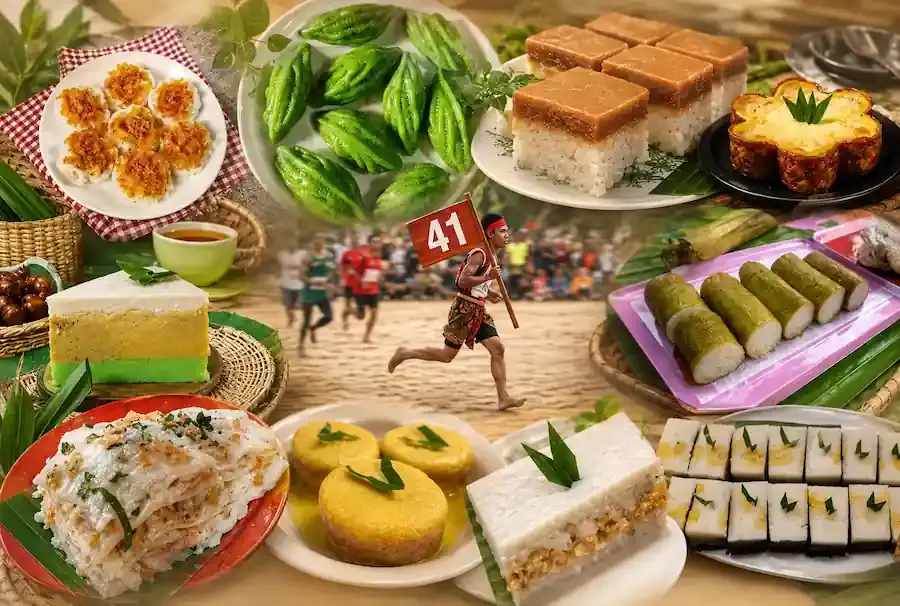
Among the dozens of varieties associated with the Wadai 41 tradition, several have become especially popular and widely recognized.
Amparan Tatak
Made from bananas and rice flour, this cake is one of the most iconic Banjar delicacies. It is known for its soft texture and distinctive white top layer.
Bingka
Bingka has a sweet flavor and a soft, custard-like texture. It is particularly popular during the month of Ramadan.
Apam Barabai
A traditional round-shaped cake that is frequently served during various customary ceremonies and celebrations.
Sarimuka
A delicious combination of a sticky rice layer and a pandan-flavored layer, creating a balance of savory and sweet flavors.
Kakicak
A traditional wadai with a unique texture that was once commonly served at special gatherings among Banjar noble families.
Putu Mayang
A delicately shaped cake resembling strands of noodles, known for its sweet taste and distinctive aroma. Many other traditional varieties also exist, including Lupis, Kokoleh, Rangai, Kalalapun, Lemper, Nagasari, and numerous other regional specialties.
Wadai 41 and the Ramadan Wadai Market
During the month of Ramadan, the people of South Kalimantan celebrate a renowned tradition known as the Ramadan Wadai Market.
This market serves as a gathering place for traditional wadai makers from various regions. Dozens, and sometimes hundreds, of varieties of Banjar cakes can be found in a single location.
For visitors, the Wadai Market is more than just a place to buy food for breaking the fast. It is also an opportunity to experience the rich cultural heritage of the Banjar people, a heritage that has been passed down for centuries.
The existence of this market helps sustain traditional wadai makers in the face of increasing competition from modern foods and commercial baked goods.
A Cultural Heritage Worth Preserving
In the modern era, the survival of Wadai 41 faces significant challenges. Younger generations are increasingly familiar with fast food and modern pastries, while many traditional recipes remain known only to elderly community members in rural villages.
Nevertheless, various preservation efforts continue. Cultural festivals, cooking competitions, the Ramadan Wadai Market, and the documentation of recipes through books and digital media all contribute to ensuring that this tradition remains alive.
Wadai 41 is far more than a collection of traditional cakes. It is a living record of the long history of the Banjar people, stretching from the era of the Negara Dipa Kingdom and the Banjar Sultanate to the present day. Within every layer of bingka, every slice of amparan tatak, and every piece of traditional Banjar confectionery lies a story of identity, belief, community, and a cultural journey that has endured for hundreds of years.
For this reason, Wadai 41 deserves recognition not merely as a culinary specialty of South Kalimantan, but as a valuable cultural heritage of the Indonesian archipelago, worthy of preservation for future generations.


From Banjar to the world, showcasing information, culture, tourism, local businesses, and products with global potential.