
A Legendary Breakfast Heritage from Hulu Sungai Recognized by the Nation
When discussing the traditional cuisine of South Kalimantan, most people immediately think of Soto Banjar. However, for many Banjar people—especially those from the Hulu Sungai Selatan region—there is another dish that holds a special place in their hearts: Ketupat Kandangan.
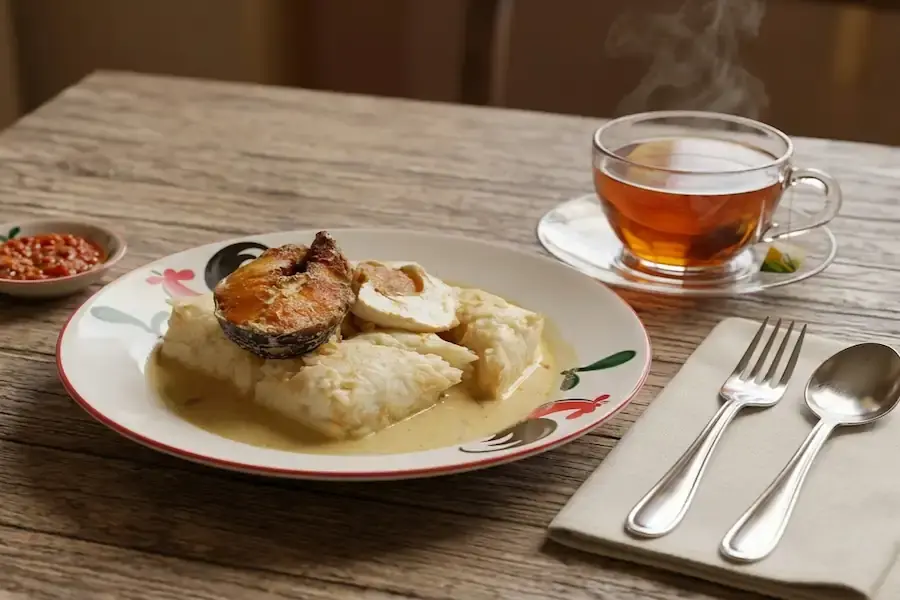
At first glance, this dish may appear similar to the ketupat vegetable dishes found in many parts of Indonesia. Yet that assumption usually changes after the very first bite. Its rich coconut milk gravy, gentle aroma of spices, and tender slices of haruan fish create a culinary experience unlike any comparable dish.
Ketupat Kandangan is more than just a traditional meal. It symbolizes the ingenuity of the Banjar people in utilizing the natural abundance of their region and demonstrates how a simple dish can endure through centuries before eventually being recognized as an element of Indonesia’s Intangible Cultural Heritage.
Born in the Fertile Land of Kandangan.
Ketupat Kandangan takes its name from **Kandangan**, the capital of Hulu Sungai Selatan Regency in South Kalimantan. For generations, this area has been known for its fertile lands, abundant agricultural products, plantations, rivers, and wetlands.
The origins of this culinary tradition are believed to date back to the 18th century. At that time, the people of Kandangan lived closely connected to rivers, swamps, and farmlands that provided a plentiful supply of food.
Haruan fish, also known as snakehead fish, became one of the community’s primary sources of protein. Easily found in the rivers and wetlands of South Kalimantan, the fish was abundant enough to inspire various methods of preparation, including cooking it with coconut milk and local spices.
The development of Ketupat Kandangan accelerated during the Dutch East Indies colonial period. The colonial government encouraged the expansion of coconut plantations to support the copra industry, which was an important export commodity.
As a result, coconuts became widely available throughout South Kalimantan. Coconut milk became an easily accessible ingredient and was increasingly used in everyday cooking. From this abundance emerged the distinctive coconut milk gravy that remains the defining characteristic of Ketupat Kandangan today.
What began as a common folk dish gradually evolved into one of the culinary identities of the Banjar people.
From Village Dish to National Cultural Heritage.
Not every traditional food survives the passage of time. Many disappear as they are replaced by modern foods or changing lifestyles.
Ketupat Kandangan, however, has demonstrated remarkable resilience.
For centuries, its basic recipe has remained largely unchanged. Communities have continued to pass down cooking techniques from one generation to the next. Breakfast stalls still serve it every morning, while Banjar families continue to present it during important celebrations and gatherings.
Its greatest recognition came in 2022, when Ketupat Kandangan was officially designated as part of Indonesia’s Intangible Cultural Heritage. This recognition honors not only the dish itself but also the traditions, knowledge, and cultural values that have been preserved through it.
The designation further confirms that Ketupat Kandangan is not merely a regional specialty but a valuable part of Indonesia’s cultural wealth.
Simple Ingredients, Extraordinary Flavor.
One of the most fascinating aspects of Ketupat Kandangan is its use of relatively simple ingredients.
Its primary component is, of course, ketupat, rice cakes cooked inside woven coconut-leaf pouches. Unlike some varieties found on the island of Java, which tend to be dense and highly compact, Kandangan-style ketupat has a slightly looser texture. Individual rice grains remain distinguishable, allowing the rice cake to absorb the gravy more effectively.
Its most important accompaniment is haruan or snakehead fish. Unlike many Indonesian dishes that serve fish separately as a side dish, Ketupat Kandangan cooks the fish directly in the coconut milk gravy and spices.
This process results in exceptionally tender fish. The seasoning penetrates deep into the flesh, creating a rich savory flavor in every bite.
The coconut milk gravy itself is prepared using a blend of white spices and selected seasonings. It is cooked slowly until it develops a thick, creamy texture while maintaining its delicate character.
The combination of ketupat, coconut milk, and haruan fish gives Ketupat Kandangan its distinctive identity and makes it difficult to replicate.
Why Do People Fall in Love with It So Quickly?.
People seeing Ketupat Kandangan for the first time often compare it to lontong sayur or Betawi-style ketupat dishes.
That impression usually lasts only until they taste it.
The most noticeable difference lies in the gravy. While similar dishes from other regions often feature a relatively light broth, Ketupat Kandangan is famous for its much thicker and richer coconut milk sauce.
Each spoonful delivers a deep savory sensation without becoming overwhelming. The coconut milk coats the palate smoothly, while the fragrant spices provide layers of flavor that encourage another bite.
The haruan fish also contributes a unique character. Its texture is soft and delicate, free from any strong fishy taste, and it blends perfectly with the rich gravy.
This combination is one reason many visitors regard Ketupat Kandangan as one of the finest breakfasts they have experienced in South Kalimantan.
The King of Breakfasts in South Kalimantan.
While Soto Banjar is enjoyed throughout the day, Ketupat Kandangan has a preferred time of its own: the morning.
In Banjarmasin and throughout the Hulu Sungai region, many food stalls become busy shortly after sunrise. Workers, traders, office employees, and travelers gather to enjoy this hearty breakfast.
A single serving is often enough to provide energy until midday. The combination of carbohydrates from ketupat, protein from fish, and natural fats from coconut milk creates a meal that is both complete and satisfying.
For this reason, Ketupat Kandangan is often referred to as the authentic breakfast of the Banjar people.
A Dish of Honor for Special Occasions.
Ketupat Kandangan is not limited to breakfast stalls.
At weddings, thanksgiving gatherings, family celebrations, and other formal events, the dish frequently appears as a featured menu item. Serving Ketupat Kandangan to guests is considered both a sign of respect and a source of regional pride.
Many families even maintain closely guarded recipes that have been handed down through generations. Each generation strives to preserve the flavors inherited from parents and grandparents.
As a result, Ketupat Kandangan carries emotional significance far beyond its role as a meal.
Two Faces of Ketupat Kandangan.
Not all Ketupat Kandangan tastes exactly the same.
Traditionally, two main variations are recognized. The first features a white coconut milk gravy with a milder and slightly sweeter flavor profile. The second is a savory version with a light yellow hue produced by the use of specific spices.
Both variations have loyal followers and retain the same essential characteristics: thick coconut milk, fragrant spices, and haruan fish as the star ingredient.
Interestingly, these variations have spread to other parts of Indonesia through Kandangan communities who migrated elsewhere. Wherever they settle, the recipe often travels with them as a reminder of home.
More Than Just Ketupat and Coconut Milk.
Ultimately, Ketupat Kandangan tells a story about the relationship between people, nature, history, and tradition.
It emerged from the abundance of haruan fish in the rivers of South Kalimantan, developed alongside the widespread availability of coconuts during the colonial era, and has been proudly passed down for centuries.
Today, every plate of Ketupat Kandangan offers not only a rich and comforting flavor but also a piece of Banjar history. It serves as a reminder that traditional food is never merely about satisfying hunger.
Behind its creamy coconut milk gravy and tender fish lies the identity of a region, memories shared across generations, and a cultural heritage now recognized by Indonesia.
And as long as there are people preparing it every morning, Ketupat Kandangan will continue to live on as one of South Kalimantan’s greatest culinary masterpieces.